Showing posts with label literature. Show all posts

Saturday, July 5, 2014

What I've Been Reading

I have, over the years, read and reread, the first few (maybe 5?) books in Winston Graham's Poldark series. There are 11 altogether, and I've recently managed to snag the rest of the books, so I was all set to read them when a copy of Longbourn came in at the library on a 7-day checkout (no renewals).


So I quickly changed my plans and dove into Longbourn by Jo Baker. I was not disappointed. It's Pride and Prejudice (sort of) told from the viewpoint of the servants in the Bennet household. So, it's less about the Bennets and more about the lives of those servants, in particular, Sarah, a young woman who had come to the household as a child but is now grown. I'm not sure I can ever read Pride and Prejudice with the same blithe disregard for the shadowy servants in the book again, but I highly recommend Longbourn.


Saturday, March 29, 2014

Libraries: Here for the Long Haul

Over the years, people have worried about "the end of things." VCRs would mean the end of theaters, for example. Having the ability to tape a song off the radio would be the end of people buying music. Neither of those things have happened, but...let's face it, we can all think of many industries/items/jobs that have vanished, become less prominent or have been replaced by alternatives. Think of the horse and carriage, the ice delivery man, chimney sweeps, switchboard operators. Times change, and the world changes with it.

The end of the community library has been predicted at one time or another, but libraries have proven themselves to be adaptable to a changing world. At one time, they were merely repositories of books. Then they added music and movies in the form of VHS tapes (which were then replaced with DVDs).

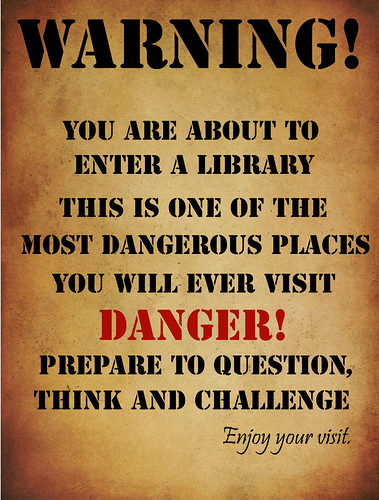
Library warning poster

And today, in the era of the ebook and streaming video, they have made even more adjustments. I was on my local library's website the other day, and from the website alone, I can check out ebooks, download movies or music, access databases, get book suggestions, ask a librarian a question, make book purchase suggestions for the library, and take part in an online book club.

If I physically visit the library, I can attend lectures or music performances, rent meeting space, borrow passes to local museums, borrow an ereader if I don't own one, or borrow a "book club in a bag" (a bag with 10 copies of a book, info on the author, suggested discussion topics, questions and other info). I can access computers to do research if I don't have my own, or I can simply use my own laptop to log onto the library's wifi.

This library at Keene State University is in charge of the "Green bikes" program, and students can check out a bicycle via the library.

library lends bikes!
Source

The library in Skokie, Illinois, has a digital media lab (equipped with computers, cameras, video cameras, scanners, microphones, musical instruments, mp3 recorders, and lots of other equipment and software, including a green screen) which patrons can use for videos, music, photos, presentations, podcasts, websites, graphic design and other types of digital presentation.

Libraries are at the cutting edge, always looking for new ways to engage the community. Some offer 3D printers, media kiosks (one article equated them to library Red Boxes) and apps for cell phones that help patrons locate materials in the library, learn more about books or get book recommendations. 

And yes, since libraries rely on tax dollars to operate, many of them are struggling these days. But they are also powerhouses of innovation. 

Long live libraries!

Friday, March 28, 2014

On Raising Readers

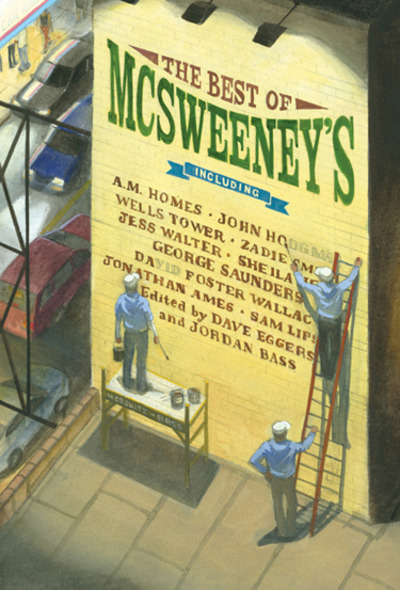
Last night I was reading, The Best of McSweeney's, a book that my youngest son gave me. And I realized that two of the books I had read in recent months had both been gifts from my children (the other one, mentioned in an earlier post and given to me by my oldest son, was Jim Henson: The Biography).


It occurred to me, not for the first time, that something wonderful had happened as my children were growing up. They had become readers, and not only readers but people who were comfortable giving books as gifts (okay, I'll concede that when your mother is a writer and a former teacher, it's not a huge leap to think that she might enjoy a book as a gift).

It brought to mind the many times over the years the topic of How Do I Get My Child to Read had come up. Admittedly, as a teacher, this was not surprising. Parents wanted me to supply the magic answer. At that time, I didn't have children of my own, but even then I thought I knew the answer, because I knew how I had become a reader myself.

My mother is/was a voracious reader. She grew up in rural America as one of six siblings, and when her mother died young, she had to drop out of school to help care for her younger brothers and sisters. Leaving school was something she regretted, but she still had her books. A love of reading is a gift that can't be taken away.

I don't remember her ever discussing books when I was very young (although she might have), but there were books in our house, and I saw her reading and enjoying reading. I think that's the key more than anything. Reading can't be forced. A parent can't just tell a child that reading is a good thing. If a parent says one thing and does another (never reads), odds are good that the child won't believe what the parent is saying.

I'm not in any way, shape or form implying that my mother set out to turn me into a reader. But I could see that reading was something she loved. And even the youngest child can make the leap from seeing the parent doing something they love to wanting to do it themselves.

So things proceeded. After my family moved north to the Chicago suburbs, she worked the night shift at a factory, so she was home with me during the day. And in the morning, after my brother and sister had gone to school and my father had gone to work, I often gathered a pile of books and pored over the pages even though I was too young to go to school and had no idea what the words said. It didn't matter. I could make up my own until I was old enough to go to school and be taught how to read (actually, I remember scribbling in one of the books with a green crayon, pretending that I was writing, something I regretted, since it clearly wasn't writing and I had messed up the precious pages. It might have been the first sign that I wanted to be a writer. More likely it was just me chafing at the bit, because I wanted to go to school to learn how to decipher the mysterious code in the books).

My mother didn't have to say a thing about reading. She had shown me by her actions. I had been infected with a passion for words and reading, because reading was clearly a desirable activity.  To this day, she and I still share that love of books and reading. I usually give her books as gifts. That's what she likes best, and I have great fun choosing them.

My husband and I are both readers, so there was no question that our home would be filled with books and that our kids would see that we both enjoyed spending time reading. There was no question that we would provide them with lots of books, read to them when they were young and take an interest in their books of choice as they grew older. Still, when my sons were young, I wondered if they would continue to read as they grew older. Life these days has so many distractions. As adults, they have jobs, hobbies, friends and lots of activities. Reading takes time. In a world where things move fast and we seem to have more activities to spread around over the same twenty-four hours we've always had, the world of books is always in danger of losing out to the next new thing.

But reading is also how people exchange complex ideas. Writers have to take time to choose their words. Readers have to take time to digest what's on the written page. It's a slower process than television or the internet, but often it's a more thoughtful process, and it's almost always a more in-depth process. This exchange of ideas is important. Losing that would be devastating to the world, but it would also mean the loss of so much joy. I hope that new readers are born every day and that the world continues to realize the importance of words.

As for me, I'm very happy that my sons are both still readers and that, despite their busy lives, they still find time to open up a book (or to choose books for their parents). It's a good feeling.

Sunday, May 12, 2013

This Was Supposed to Be a Post About Limerick Day

Limerick Day celebrates the birthday of  Edward Lear who popularized the limerick in his A Book of Nonsense in 1846, but on my way to finding a visual to go with this post, I came across several lovely images totally unrelated to Limerick Day.

For example, this photo has nothing to do with the word limerick as a form of poetry but was taken not far from the city of Limerick in Ireland.

It's a long way to Tipperary

And then there's this gorgeous image:Flowery Friday
Source

And this wonderful signpost (only 6k to Limerick):
Co.Clare Fingerpost - signpost, Ireland April 1989
Source

So...I lost sight of my goal, but not for long. This day, after all, is about Edward Lear and his limericks. And to that I say, Happy Birthday, Edward Lear! And thank you for your contribution to literature.

UK - London - Marble Arch: Edward Lear Hotel - Edward Lear blue plaque

One of Edward Lear's limericks (I'm sure you know this one):

There was an Old Man with a beard,
Who said, “It is just as I feared!—
Two Owls and a Hen, four Larks and a Wren,
Have all built their nests in my beard!”

For more of Edward Lear's poems or to read biographical material, go to Poem Hunter.